

Audio By Carbonatix
Today is Local News Day
A national day of action to support and celebrate the trusted local journalism that strengthens communities. If you believe local news matters — this is the day to show your support. Make a contribution today to help keep our reporting free and accessible to all.
Trains are pretty much pure Americana. Sure, there were trains in other places, but you can keep your Orient Expresses and your trips to Hogwarts leaving from Platform Nine and Three Quarters. Trains grew up with America herself. They invoke visions of steel-driving men, of old West robberies, of trestles that span canyons, of hellos and goodbyes at stations where you could run alongside a train as it whistles away or to a stop.
And that goes for toys, too — the train around the Christmas tree was so common it became a mid-century cliche such that even the Grinch himself stole it from under a Who family’s tree. Trains — both operational and playthings — are quintessential to America.
Which is why the Rocky Mountain Train Show has not only survived but thrived here in Denver, with its 41st show coming up April 11-12 at the National Western Complex. Covering 120,000 square feet and boasting an attendance of well over 10,000, it’s the largest such show this side of the Mississippi.
It may well be one of the oldest as well, having established itself back in 1976, when the Rocky Mountain Division of the Train Collectors Association announced its first “Holiday Meet” to be held Thanksgiving weekend. Attendance was strong early on but waned over the years until 2009, when the RMD expanded to the Denver Mart and began advertising extensively, which brought in crowds again. It’s been a labor of love — and a golden-spike success — ever since.
“The hobby is really one that appeals to all ages,” says Greg Hurd, director and past president of RMD. And Hurd should know — he’s not only authored several train reference books, but he was there at the very beginning of the show back in 1976.
But his love for model trains? “That goes back 76 and a half years,” he laughs. “I got my first train set when I was six months old, as a Christmas present. I think my dad was the one who wanted a train back then, you know? But I got another one the next Christmas, and after that, I was hooked. I liked trains.”
Hurd still has that first train he got as an infant. “I have it set up down in my basement,” he says. “It was a Marx train, and had a little key you had to wind up, and it went around a little oval track. It still works!”
It’s the hobbyist in Hurd that speaks to the longevity of that early train set, but he says it was really a lesson he learned from his parents when he was a kid. “They said these were expensive toys, take care of them,” he recalls. “But literally, I’ve worn a couple of them out over the years, and had to fix them up with replacement parts and such.”
And it’s not just the trains that are the draw for aficionados — it’s the environments they choo-choo through. Some setups are charmingly hand-made, tunnels carved out of styrofoam, trees just branches from the backyard, buildings made of cardboard and painted with markers. Other setups are more realistic, with scale models made specifically for train displays, with variants for different seasons, locales or eras of history.
Hurd remembers making a lot of the environments in his train layouts, especially when he was a kid and money was sometimes tough to come by. Still, he managed to create two major displays down in his basement — one laid out flat, and another that he suspended from the ceiling. “I made the mountains and the bridges and all that. I was crazy back then,” he jokes. “Just crazy.”
One of those layouts was an American Flyer train, one of the early companies that competed with the better-known-to-the-public Lionel company. “Those were larger trains,” Hurd explains. “The other was a little HO gauge that I won selling Christmas cards with the Boy Scouts. So the smaller HOs hung from the ceiling, and the American Flyers had the table beneath.” (HO is short for “half-O,” referring to the larger O gauge in which many of the American Flyers were built — HO is 1:87 scale.)
It might surprise some to hear that Hurd — and a lot of other kids in the 1950s — could afford to have more than one train. Model trains have the reputation of being on the pricey side, but Hurd says that’s overblown. “Sure, you can spend money on anything,” says Hurd, “but the Marx Company, Lionel, American Flyer, they all had what we called entry-level sets. Sears and Montgomery Ward and Firestone all had these really low-cost sets. And then if you got serious about it, you moved up to a new level, which were more accurate in terms of detail, had some bells and whistles.”
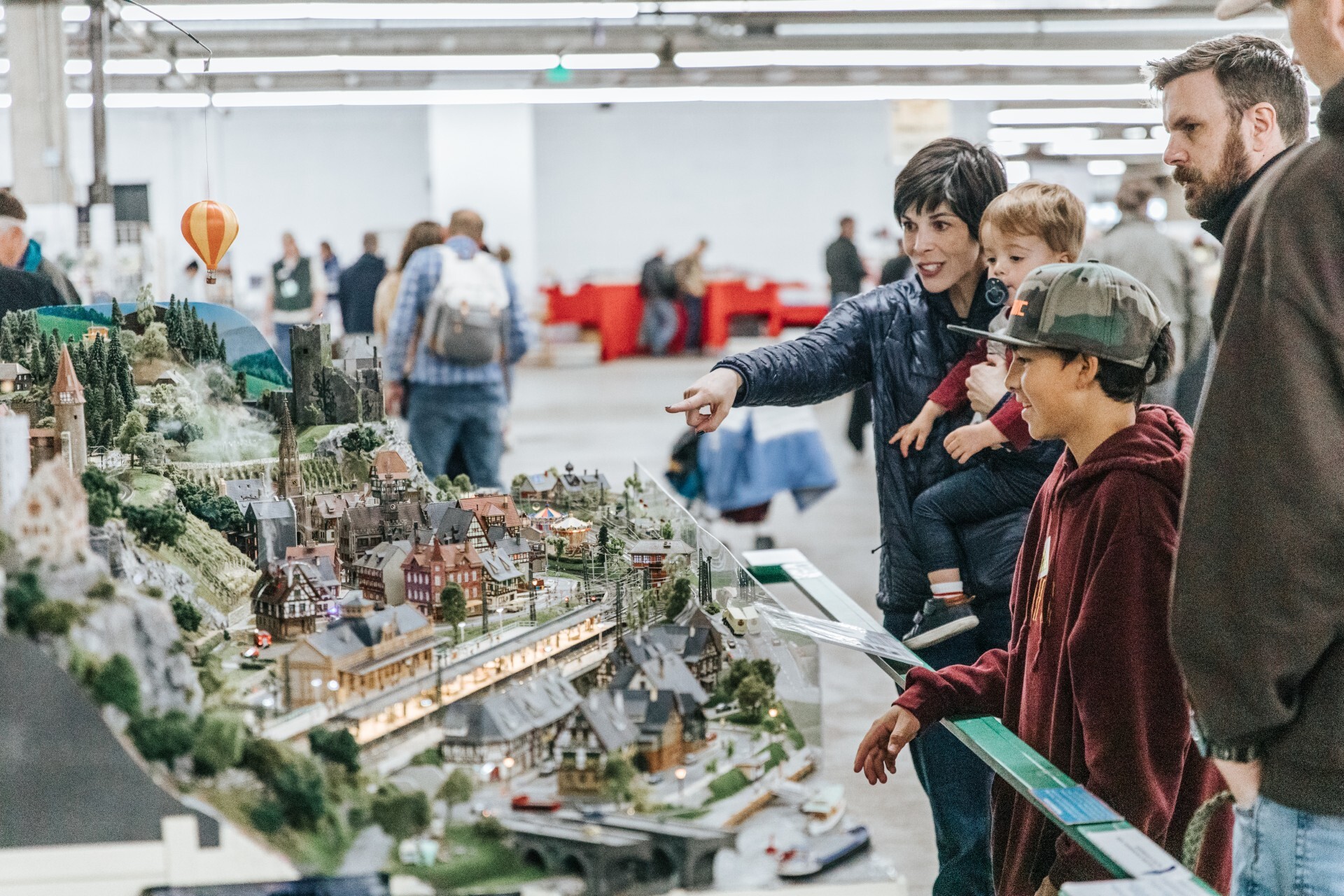
Those details, the bells and whistles and real smoke coming out of that scale-stack, the tell-tale smell of oil and metal, all those things are what make the Rocky Mountain Train Show a success. “Kids love trains,” says Hurd. “They see these things in miniature and maybe they’ve never even been on a train before, but they’re still drawn to them. And then the parents, even if they’ve never owned a train set, they see their kids responding to it, and then they’re interested too. It really is as much about families, this show, as for the hobbyists.”
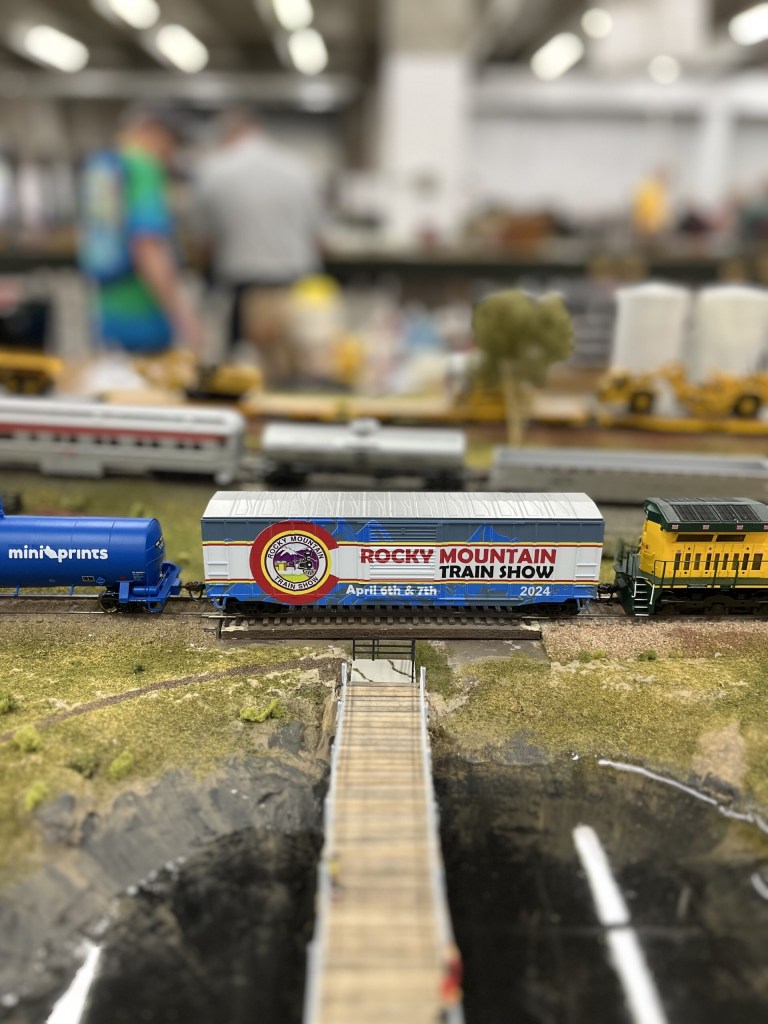
The features of the Rocky Mountain Train Show bear that out: For any train-fans worth their engineer caps, the 115 vendors, 22 manufacturers, scenic railroad displays, seven museums, an equal number of historic societies, nearly thirty hobbyist groups showing off their layouts, and over 750 tables of trains both for sale and just for admiring make this show a wonderland. But the kids are just as important, which is why the show offers youth the opportunity to run and race model trains, build a G-scale train car, ride on a train themselves, and romp in a train-themed play area. The show also partners with the Colorado Model Railroad Museum, which gives kids the chance to build a LEGO train car and watch it ride the rails.
Kids and families are prioritized in terms of cost; while standard admission is $16 at the door or on the show’s website, discount tickets are available at Colpar Hobbies and Rocky Mountain Train Supply, as well as at the Colorado Model Railroad Museum in Greeley. Parking is free; kids 12 and under get free admission, as do any Scouts who attend in uniform. (Veterans and first responders can also get tickets through VetTix.) Admission, once purchased, is good for both days of the show.
“For a lot of people, I think it brings back memories,” Hurd says. “Whether you grew up with them or not, it’s sort of been part of the American experience. It’s about nostalgia. It’s still in our blood.”
The Rocky Mountain Train Show is April 11-12 at the National Western Complex, 4655 Humboldt Street.